Can Minerals Get Wet Safely? A Collector’s Guide
A beautiful specimen can look perfectly solid on a shelf, then react very differently when water touches it. If you have ever wondered, can minerals get wet safely, the honest answer is: some can, some absolutely should not, and many need a little more context than a simple yes or no.
Water care is not about being overly cautious with your collection. It is about honoring the natural character of each piece. Minerals form under extraordinary conditions, but that does not mean every crystal belongs under a faucet, in a bath, or outside in the rain. A thoughtful approach helps preserve the color, luster, structure, and meaning that drew you to a piece in the first place.
Can Minerals Get Wet Safely? It Depends on the Mineral
A mineral’s response to water depends on its chemical composition, hardness, crystal structure, surface treatment, and how long it remains wet. Some durable stones can handle a brief rinse and dry beautifully. Others absorb water, fade, oxidize, flake, dissolve, or develop a dull finish.
A useful starting point is the Mohs hardness scale, which measures scratch resistance. Minerals below about 5 or 6 on the scale often deserve extra care, but hardness alone is not the whole story. Pyrite, for example, is fairly hard, yet moisture can encourage oxidation. Selenite is soft and water-soluble. Some polished stones may be dyed, coated, stabilized, or glued, meaning water can affect the finish even when the underlying mineral is relatively durable.
For collectors, the safest assumption is simple: unless you know your specimen is water-safe, keep it dry. This is especially true for rare, delicate, raw, druzy, or matrix-bearing pieces. The more natural details a specimen has, the more places water can settle unnoticed.
Minerals That Usually Handle a Brief Rinse
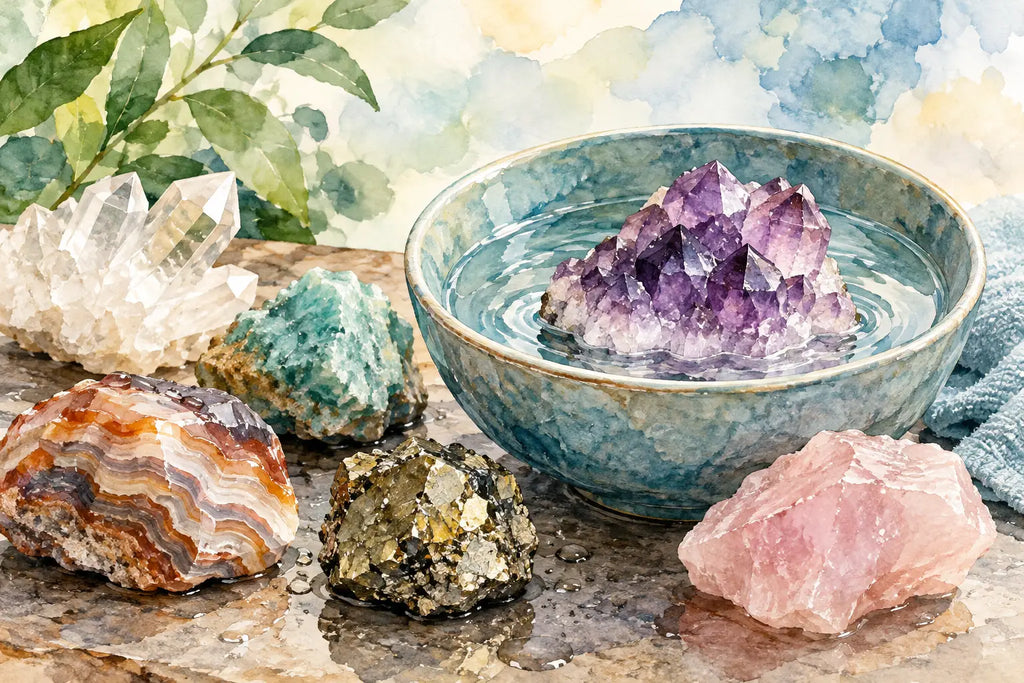
Many common, hard, nonporous stones can tolerate a quick rinse with clean room-temperature water, followed immediately by gentle drying. Clear quartz, rose quartz, amethyst, smoky quartz, agate, jasper, chalcedony, and many forms of petrified wood are generally among the more water-tolerant choices.
Even with these pieces, “water-safe” does not mean “soak-safe.” A quick rinse to remove dust is very different from leaving a crystal in a bowl overnight. Long soaking can expose tiny fractures, affect inclusions, loosen display adhesives, or leave mineral deposits behind if your tap water is hard.
If you choose to rinse a durable stone, use lukewarm or room-temperature water rather than hot water. Sudden temperature changes can stress stones with internal fractures or layered compositions. Pat the piece dry with a soft, lint-free cloth, then let it air-dry fully before returning it to a closed display, pouch, or collection tray.
Crystals and Minerals Best Kept Away From Water
Some minerals are simply happier dry. Selenite and satin spar gypsum are among the best-known examples because they can soften or slowly dissolve with exposure to water. Halite is salt, so it dissolves readily. Lepidolite can be fragile and flaky, while kyanite may separate along its natural blades.
Other pieces can be harmed less dramatically but still noticeably over time. Malachite, azurite, chrysocolla, turquoise, lapis lazuli, and angelite are often porous or sensitive enough that soaking is not a good choice. Water may alter their surface, work into fine cracks, or interact with materials used in polishing and stabilization.
Be especially careful with minerals that contain metal. Pyrite, marcasite, hematite, and some mixed mineral specimens may rust, tarnish, or develop changes in color when moisture lingers. Copper-bearing minerals deserve mindful handling as well. Their vivid blues and greens are part of their magic, and they are worth protecting.
Avoid water entirely for pieces with delicate formations, including desert rose, flower-like clusters, thin blades, friable matrix, or glittering druzy surfaces. A rinse may not visibly damage them right away, but water can lodge deep in crevices and create problems later.
Why Salt Water, Moon Water, and Soaking Carry More Risk
Many crystal care traditions include cleansing with salt water, moon water, or a long soak. These rituals can feel meaningful, but they are not universally safe for physical specimens. Salt water is particularly harsh because salt can scratch surfaces, leave residue, and accelerate corrosion in metal-containing minerals.
Moon water presents a different concern. The water itself may be plain, but placing crystals outdoors overnight introduces humidity, dew, shifting temperatures, and the possibility of rain. A clear quartz point may be fine in a protected setting, while a pyrite cluster or selenite tower is better left indoors near a windowsill.
The intention behind a ritual does not require direct contact with water. You can place a crystal beside a bowl of water, use sound, hold it in your hands during meditation, pass it through incense smoke with appropriate ventilation, or simply set a fresh intention while gently dusting it. The care can be every bit as personal without putting the piece at risk.
How to Clean a Mineral Without Water
Dry cleaning is often the kindest and most collector-friendly method. Start with a soft makeup brush, artist’s brush, or clean microfiber cloth. Use light pressure, especially around points, seams, crystal terminations, and natural pockets where fragile material may be hiding.
For a polished palm stone or sphere, a dry microfiber cloth is usually all you need. For raw clusters, a soft brush can lift dust from between crystals without forcing moisture into the formation. A handheld air blower, used gently and at a distance, can also help with hard-to-reach areas. Avoid canned compressed air, which can be forceful and may leave residue or cause a sudden temperature change.
If a durable specimen has stubborn surface grime, first confirm its identity and any treatments. Then consider a barely damp cloth rather than immersion. Wipe only the solid, stable area, dry immediately, and allow the piece to rest in open air. When a mineral is rare, sentimental, or valuable, professional conservation advice is the most thoughtful route.
A Simple Water-Safety Check Before You Clean
Before any water touches your crystal, pause for a quick assessment. Do you know exactly what mineral it is? Is it raw, polished, dyed, coated, or part of a mixed specimen? Does it have visible cracks, a soft or chalky feel, metallic areas, or a porous matrix?
If the answer to any of these questions is uncertain, treat it as dry-care only until you can verify it. This is not restrictive. It is a way of being present with your collection and learning the individual story of each piece.
Also consider where the mineral lives. A bathroom shelf, kitchen windowsill, humid sunroom, or outdoor altar can expose crystals to ongoing moisture even if they are never intentionally washed. Displaying sensitive pieces in a dry interior space helps preserve them. For metal-bearing minerals, a silica packet nearby can be useful in especially humid climates, as long as it is kept out of reach of children and pets.
Care Is Part of the Connection
Every mineral has its own boundaries. A hardy quartz tower may welcome an occasional gentle rinse, while a satin spar wand is best loved with a soft brush and a dry display. Neither is less beautiful or less meaningful because it needs different care.
At Bellissima Crystals, we believe a collection becomes more personal as you learn what each piece needs. Let water be one more intentional choice: use it when it supports the stone, skip it when it does not, and give your minerals the kind of lasting care that lets their natural beauty stay with you for years.