Crystal Hardness Scale Guide for Collectors

A luminous selenite tower and a polished rose quartz palm stone may both look at home on the same shelf, but they need very different care. This crystal hardness scale guide helps you understand why, so you can choose pieces that fit your life and protect the ones already meaningful to you.
Hardness is one of the quiet details that separates a crystal you can carry every day from one best admired in a carefully chosen display. It does not measure a stone’s beauty, energy, rarity, or value. It simply tells us how readily one mineral can scratch another. Once you know where a crystal falls on the scale, caring for your collection feels less uncertain and much more intuitive.
What the crystal hardness scale means
Most crystal sellers and collectors use the Mohs hardness scale, a mineral scale created to compare scratch resistance. It runs from 1 to 10. A mineral with a higher number can generally scratch a mineral with a lower number.
The scale is relative, not evenly spaced. Diamond, at 10, is not just a little harder than corundum at 9. It is dramatically harder. That is why a diamond can scratch nearly every other natural mineral, while a beautiful quartz point may still pick up marks from harder materials.
Here is the practical framework collectors use:
| Mohs hardness | Familiar examples | What it usually means for care |
| --- | --- | --- |
| 1-2 | Talc, gypsum, selenite | Very soft. Handle gently and keep away from harder stones. |
| 3-4 | Calcite, fluorite, malachite, celestite | Easy to scratch or chip. Best for intentional display and gentle handling. |
| 5-6 | Apatite, obsidian, feldspar, moonstone | Moderate durability, but still vulnerable to knocks and loose storage. |
| 6.5-7 | Labradorite, pyrite, quartz, amethyst, citrine | Suitable for regular handling with sensible care. |
| 8-10 | Topaz, corundum, diamond | Highly scratch-resistant, though not automatically immune to chips or fractures. |
A higher Mohs number does not mean a crystal is indestructible. A mineral can resist scratches yet still break if dropped, split along a natural cleavage plane, or react badly to chemicals. Hardness is one important part of the story, not the whole story.
Crystal hardness scale guide: common favorites
Soft crystals: 1 to 4
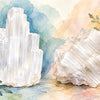
Selenite, often sold under its mineral name gypsum, sits near 2 on the Mohs scale. Its silky glow and soothing presence make it a beloved display piece, but it is easily scratched. It can also be affected by prolonged contact with water. Keep selenite on a stable surface, dust it with a soft dry cloth, and give it its own space rather than placing other crystals on top of it.
Calcite is around 3, while fluorite ranges around 4. Both can have incredible color, clarity, and collector appeal, especially in raw formations with delicate edges or cubic growth. They are better treated as specimens than as loose pocket stones. A fluorite point may look substantial, yet its corners can chip quickly when it shares a bag or drawer with quartz.
Malachite generally falls around 3.5 to 4. Its rich green banding makes it unforgettable, but it deserves gentle, dry care. Avoid household cleaners and extended soaking. As with any mineral, a piece’s finish, fractures, and treatment history can affect how it should be handled.
Everyday favorites: 5 to 7
Many well-loved crystals land in this middle range. Obsidian is around 5 to 5.5. It can take a lovely polish but has a glass-like character and may chip at thin edges. Moonstone and labradorite are usually around 6 to 6.5. Their flashes of light are captivating, though they can be vulnerable to hard impacts, especially in rings or pieces with exposed corners.
Quartz is a favorite for both new crystal lovers and longtime collectors because it is about 7 on the Mohs scale. Clear quartz, amethyst, citrine, rose quartz, smoky quartz, and many other quartz varieties have enough scratch resistance for frequent handling and thoughtful everyday wear. They still benefit from individual storage, particularly around topaz, corundum, diamonds, or metal hardware.
Pyrite is often listed around 6 to 6.5. Its metallic sparkle can make it seem tougher than it is. Many pyrite clusters have sharp formations and natural seams, so protect them from hard knocks and excessive moisture. Hardness alone cannot tell you whether a specimen is structurally delicate.
Harder stones: 8 to 10
Topaz ranks at 8, and corundum varieties such as ruby and sapphire rank at 9. Diamond sits at 10. These minerals offer excellent scratch resistance, which makes them popular in jewelry. Still, they can chip under the wrong force, especially where there is cleavage, a thin point, or an existing fracture.
This is a helpful reminder for collectors: a harder stone is not necessarily the better stone. A fragile celestite cluster may be a more extraordinary and meaningful addition to your space than a durable polished quartz, simply because its formation, color, or story speaks to you.
Hardness is not the same as toughness
Hardness answers one question: can this surface be scratched? Toughness answers another: can this material withstand a blow without breaking? Glass is a useful comparison. It can resist some scratches, yet it may shatter when dropped.
Crystals have their own internal structures. Some split cleanly in certain directions, a property called cleavage. Others are prone to fractures, have thin terminations, or grow in fragile sprays and clusters. A crystal’s cut matters, too. A smooth tumble usually has fewer exposed edges than a raw point or a finely carved sphere stand.
Kyanite offers an especially interesting example. Its hardness can vary depending on the direction tested within the crystal. This is one reason a single number is a useful guide, not a complete care manual.
Choosing crystals for your lifestyle
If you love carrying a stone in a pocket, placing one on your desk, or reaching for it during meditation, quartz varieties are usually forgiving choices. A polished amethyst heart or rose quartz worry stone can become part of a daily ritual without requiring constant concern.
If you are drawn to soft, rare, or highly detailed specimens, let their care become part of the experience. Place them where they are less likely to be bumped by pets, children, or busy hands. Use a stable shelf, a padded tray, or a display case when appropriate. Keep heavier pieces low, and do not stack crystals unless you know they can safely touch.
For jewelry, consider both hardness and how the piece will be worn. A moonstone pendant faces less daily impact than a moonstone ring. A fluorite ring can be beautiful for occasional wear, while a quartz bracelet may be a more practical companion for everyday use. There is no wrong choice when expectations and care match the stone.
Storage and cleaning with care
The simplest habit is also one of the best: store crystals so they do not rub against one another. Wrap softer polished pieces in soft cloth or place them in separate compartments. Raw clusters need breathing room so points and delicate formations do not catch on neighboring specimens.
For routine cleaning, a soft dry brush or microfiber cloth is often enough. If a mineral is known to tolerate brief contact with water, use a lightly damp cloth and dry it promptly. Do not assume every crystal is safe to soak, steam, or cleanse with salt. Water-soluble minerals, porous stones, metallic minerals, and pieces with fractures all need extra consideration.
Be thoughtful about sunlight as well. Hardness does not protect color. Some minerals, including certain amethyst and fluorite pieces, may fade with prolonged direct sun exposure. A bright room can still be a beautiful place for them, especially when the piece is set back from a harsh windowsill.
Avoid testing hardness at home by scratching a crystal with glass, metal, or another stone. Those tests can leave permanent marks and are especially unwise for polished, rare, or sentimental pieces. Trusted mineral identification considers several qualities together, including crystal habit, luster, transparency, locality, and professional assessment when needed.
At Bellissima Crystals, we believe care is part of connection. Knowing a piece needs a gentler shelf, a soft pouch, or a little more space does not make it difficult. It gives you another way to honor the natural journey that brought it into your collection.
Let hardness guide your practical choices, then let your eye and heart lead the rest. The crystal you treasure most does not have to be the toughest one. It only needs a place where its beauty can be enjoyed, protected, and appreciated for years to come.