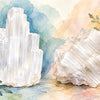
How to Identify Crystal Damage Before You Buy

A tiny line in a crystal can make your heart skip - especially when you have just unwrapped a piece chosen for its beauty, energy, or place in your collection. Learning how to identify crystal damage helps you look closely without losing the wonder. Not every mark is a problem. Many of the details that make a mineral specimen feel alive were formed deep within the earth, long before it reached your hands.
The goal is not to expect perfection. It is to understand what you are seeing, make confident purchasing decisions, and give a meaningful piece the care it deserves.
How to Identify Crystal Damage With a Close Look
Begin in bright, indirect natural light or under a soft lamp. Hold the crystal at several angles rather than judging it from one view. A mark that seems dramatic head-on may disappear when turned, while a surface chip can become much clearer when light catches its edge.
Damage usually appears as a change to the crystal's surface or structure after it was formed. Look for a fresh-looking chip, a rough break where the surrounding finish is smooth, or a crack that runs from an edge into the body of the piece. On polished stones, damage often interrupts the sheen. A scratch may look dull, pale, or white compared with the glossy area around it.
Run a clean fingertip lightly across the spot. A surface-level scratch can often be felt, while a natural internal feature generally cannot. Do not press on a fracture, pry at an edge, or use a fingernail to test a suspected crack. Fragile minerals can be harmed by even a well-meant inspection.
A magnifying loupe can be useful for collector-grade specimens, but your eyes and a gentle touch are often enough. What matters most is whether the feature affects the stability, display quality, or character of the piece.
Signs of a recent chip or break
A chip is typically found on a point, corner, edge, or thin projection - the places most likely to meet a hard surface. It may feel sharp or irregular, and it can expose a lighter, unpolished area beneath a polished surface. On raw clusters, a break can look noticeably different from the surrounding crystal faces: less reflective, more granular, and lacking the natural growth pattern seen nearby.
That said, raw crystals are not manufactured objects. A rough edge is not automatically damage. Many specimens are separated from a larger matrix or naturally grow with incomplete terminations. Context matters. Compare the area with the rest of the piece and consider the mineral's natural form.
Cracks, fractures, and internal lines
A crack that reaches the surface deserves closer attention, particularly if it travels through a point, a thin slab, or a carving with narrow details. It may catch light as a bright line and feel slightly uneven under your finger. If the line appears to widen at an edge or has a visible gap, the piece may be more vulnerable to a future break.
Internal lines are different. In quartz, for example, veils and healed fractures can create beautiful flashes, rainbows, or misty layers inside the stone. These are often natural records of the crystal's growth journey. If the line is fully enclosed and the exterior remains smooth, it is generally an inclusion or internal fracture rather than fresh damage.
A healed fracture may look like a delicate seam where the crystal broke and continued growing underground. Collectors often value these features because they make every specimen distinct. They are not necessarily a concern unless the piece feels structurally unstable or the fracture opens at the surface.
Natural Features That Are Often Mistaken for Damage
Some of the most common worries are actually signs of authenticity. Inclusions, color zoning, druzy pockets, mineral deposits, and natural texture are part of what gives a crystal its individual personality.
Cloudiness inside clear quartz is often caused by tiny inclusions or internal planes. Black needles in tourmalinated quartz, golden threads in rutilated quartz, and shimmering layers in labradorite are desired natural characteristics, not flaws. In fluorite, banding and internal cleavage lines may be visible even in a carefully handled piece because fluorite naturally cleaves in specific directions.
Small pits or uneven areas can also be part of a raw specimen's growth. Amethyst clusters may have differing point heights, calcite may show distinct cleavage faces, and tourmaline can have natural striations along its length. A hand-polished freeform may retain a small natural depression because removing it would require taking away too much material.
There is a meaningful trade-off here. A perfectly uniform, highly polished stone may be ideal if you want a sleek decorative piece. A specimen with inclusions, matrix, or natural variations may feel more expressive and collector-forward. Neither is better. The right choice is the one that makes sense for how you want to enjoy it.
Use Photos to Inspect a Crystal Before It Arrives
When shopping online, look beyond the main glamour photo. Clear images of multiple angles, close-ups of points and edges, and honest descriptions give you a much stronger sense of the piece. Ask whether a visible line is internal, whether a point has a chip, and whether any repairs or stabilizing work have been done.
A reputable seller should be comfortable describing notable characteristics clearly. Natural inclusions and minor formation marks are normal, particularly in raw and rare minerals. A significant break, glued repair, or instability should not be treated as a mystery.
If you receive a crystal and notice something unexpected, photograph it in soft daylight before moving it around too much. Take one image of the full piece and several close-ups of the area in question. This is useful for your own records and makes it easier to have a clear, respectful conversation with the seller if needed.
Check for Repairs Without Assuming the Worst
Repairs are not always deceptive. Some fragile mineral specimens are professionally stabilized so they can be safely displayed and enjoyed. The concern is not that a repair exists, but whether it was disclosed and whether it is appropriate for the piece.
Look for clear, glassy material along a break line, an unusually shiny seam, or a color change around a fracture. Adhesive can sometimes collect dust differently than the mineral surface. On clusters or delicate formations, inspect where a point joins the matrix and where thin protrusions meet the main body.
Avoid home repair experiments with glue, oils, or coating sprays. The wrong adhesive can discolor over time, seep into porous material, or reduce a specimen's future value. For a cherished or rare piece, a qualified mineral conservator is the safest person to advise on stabilization.
A Gentle Inspection Routine for Your Collection
Once a crystal is home, a simple routine can help you catch handling damage early without turning care into a stressful ritual:
- Inspect delicate points and thin edges before and after moving a display.
- Lift heavier pieces from the base with two hands, never by a point or cluster.
- Keep specimens separated so hard minerals do not scratch softer ones.
- Display sensitive crystals away from busy ledges, direct sun, moisture, and sudden temperature changes.
- Save a few well-lit photos of special pieces for condition records.
When Damage Changes the Way You Care for a Crystal
A small chip does not erase a crystal's beauty or meaning. It may simply mean choosing a safer display spot, handling it less often, or appreciating it as a well-loved part of your collection. But an active crack, loose point, or crumbling area calls for more caution. Move the piece as little as possible, support it from underneath, and keep it away from vibration.
For many collectors, the most memorable crystals are not flawless. They have a luminous inclusion, an unexpected formation mark, or a history that makes them unmistakably theirs. Careful observation lets you honor both the mineral's natural story and the journey that brought it to you. Hold it gently, look closely, and let its character matter as much as its condition.