Rare Minerals Versus Common Crystals: What Matters?
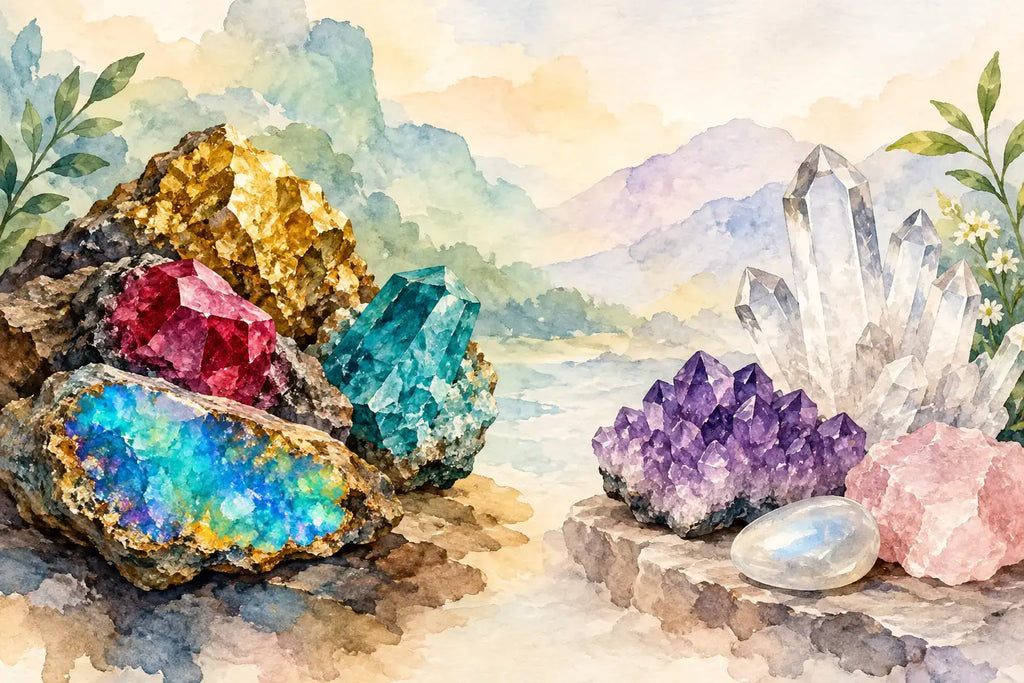
A soft pink rose quartz palm stone may be easy to find, while a vivid cluster of lavender smithsonite can stop a seasoned collector in their tracks. Both can be beautiful. Both can feel meaningful. But when choosing between rare minerals versus common crystals, rarity is only one part of the story.
The piece that belongs in your hands or on your shelf is not always the hardest one to source. It may be the crystal whose color makes you pause, the mineral specimen with a remarkable formation, or the stone that supports a personal ritual. Understanding the difference helps you shop with confidence, appreciate what you are receiving, and choose with intention rather than pressure.
Rare Minerals Versus Common Crystals: The Real Difference
A mineral is a naturally occurring substance with a particular chemical composition and crystal structure. A crystal is often used as a broader retail term for a mineral that has formed in a recognizable crystalline structure, whether it is left raw, polished, carved, or tumbled. In everyday crystal collecting, the words are often used interchangeably, and that is perfectly understandable.
When we call a mineral rare, we usually mean it is scarce in nature, found in relatively few localities, difficult to mine, or available only in limited quantities. Benitoite, serendibite, and fine-quality red beryl are examples of minerals with genuine geological scarcity. Others may not be rare in a scientific sense but are rare in a particular color, crystal habit, size, or quality.
Common crystals, by comparison, are more widely available. Quartz, amethyst, clear calcite, fluorite, and rose quartz are familiar favorites because deposits occur in multiple regions and material enters the market more consistently. “Common” does not mean lesser. A luminous amethyst with deep color, elegant points, and a balanced formation can be every bit as captivating as a harder-to-find specimen.
Rarity is a fact about availability. Beauty, resonance, and craftsmanship are personal. The two do not always move together.
Why Two Similar Pieces Can Have Very Different Prices
Price is often where shoppers feel uncertain, especially when they see two pieces that appear similar at first glance. A rare mineral may command a higher price because the rough is limited, extraction is difficult, or only a small percentage of material is suitable for collectors. Transport, careful handling, and the skill required to preserve fragile crystals can also affect cost.
Yet a common crystal can be expensive for very good reasons. Exceptional clarity, rich saturation, sculptural formation, large size, an uncommon inclusion pattern, and artisan polishing all add value. Think of quartz: it is abundant globally, but a high-quality garden quartz sphere with beautifully defined inclusions is not interchangeable with an ordinary clear quartz tumble.
The origin of a piece matters, too. Material from a celebrated locality may be valued for its distinctive look or limited output. When a mine closes, changes ownership, or stops producing a certain grade of material, existing specimens can become more desirable over time. That does not guarantee future financial appreciation, but it does give a piece a meaningful collector context.
A thoughtful price reflects more than a label. It can reflect the journey from mine to maker, the care given to selecting the piece, and the qualities that make it genuinely special.
Natural rarity and market rarity are not the same
Some stones become “rare” because they are trending online, rather than because they are geologically scarce. Demand can rise quickly after a striking material appears in live sales or social media posts. A temporary supply shortage can have the same effect.
That does not make the stone less worthy of enjoyment. It simply means it is helpful to ask what kind of rarity is being discussed. Is the mineral itself uncommon? Is this color or formation unusual? Is it from a limited locality? Or is it currently difficult to source because demand is high? A transparent seller should be comfortable sharing what they know without turning every beautiful piece into a once-in-a-lifetime claim.
What Makes a Common Crystal Feel Exceptional
The most memorable collections are rarely built on rarity alone. They are built on pieces that have character.
A common mineral can feel extraordinary when it has a rare visual quality: a rainbow caught within clear quartz, dramatic phantom layers, a naturally formed heart-like silhouette, sparkling druzy, or a soothing color that fits your space perfectly. A polished piece can also be special because of the lapidary work. The cut may reveal a hidden pattern, create a satisfying shape for meditation, or turn an everyday material into a lasting display object.
There is also comfort in accessible crystals. If you are drawn to working with rose quartz, black tourmaline, or amethyst regularly, it can be reassuring to know that a beloved stone is available in many forms and price points. You can choose a small pocket companion, a sphere for your desk, or a larger statement piece without treating the experience like a high-stakes investment decision.
For new collectors, common crystals are often an inviting place to learn. You can notice differences in color, polish, weight, transparency, and formation while discovering what you are naturally drawn to. Your eye develops through time spent with many pieces, not just expensive ones.
How to Choose With Intention
Before focusing on a rarity label, ask yourself what you want this piece to bring to your life. Are you building a mineral display? Marking a personal milestone? Looking for a meaningful gift? Choosing a crystal to hold during quiet moments? Your answer can point you toward the right kind of piece.
For a collector, a rare mineral may be especially compelling when it has a documented locality, strong crystal definition, minimal damage, or an unusual association with other minerals. Study the specimen from every angle when photos or videos are available. Natural chips, contact points, and matrix are not automatically flaws. They are often part of the specimen’s story, especially in raw material.
For someone seeking beauty and emotional connection, a common crystal may be the more satisfying choice. There is no need to justify a piece with scientific scarcity if its color feels like home or its shape makes you smile every time you see it. The right crystal is often the one you keep returning to.
Gift buyers can make the choice simpler by considering the recipient’s style. A refined clear quartz point suits someone who loves clean, luminous decor. A warm banded agate may feel personal and grounding for someone who enjoys earthy textures. If you do not know their favorite mineral, choose a well-made piece with a timeless look instead of chasing a rare name they may not connect with.
Sourcing Is Part of a Crystal’s Meaning
A beautiful piece carries more heart when its path has been considered. Ethical sourcing in the mineral world is not always simple. Supply chains can involve small-scale miners, local traders, cutting workshops, exporters, and artisans across different countries. Conditions vary widely by region and material.
The goal is not to expect a perfect answer to every question. It is to choose sellers who value long-term relationships, ask questions about origin and handling, avoid misleading claims, and treat each piece as more than anonymous inventory. Responsible sourcing can mean supporting skilled artisans, paying fairly for quality material, and selecting specimens carefully instead of buying indiscriminately in bulk.
At Bellissima Crystals, that careful selection is part of the experience. A crystal is chosen not only for its name, but for its color, energy, formation, and the feeling it may bring to its next home.
Questions worth asking before you buy
When a piece is described as rare, a few gentle questions can bring clarity. Ask whether the mineral is naturally rare or whether the specific feature is unusual. Ask about the stated origin if it is known. If the price is higher than expected, ask what qualities account for it: size, clarity, color, crystal formation, locality, or limited supply.
It is also reasonable to ask whether a material has been treated, dyed, coated, or stabilized. Treatments are not inherently wrong, particularly in jewelry and decorative pieces, but they should be disclosed clearly. Transparency lets you choose according to your preferences and care for the piece properly.
Let Your Collection Tell Your Story
A collection made entirely of rare minerals can be fascinating, but it may not feel complete without the familiar pieces that comfort you. Likewise, a collection of accessible crystals can be deeply personal and visually beautiful without needing a single collector-grade rarity.
Consider mixing both. Let a treasured rare specimen be the focal point of a shelf, then surround it with crystals you use and love every day. Pair a delicate, hard-to-find mineral with a substantial quartz point. Display a prized locality piece beside a simple sphere in a color that makes your room feel warmer. Contrast often makes each piece more noticeable.
There is no need to rush toward the rarest item in the room. Let yourself learn, ask questions, and choose the pieces that keep their meaning after the excitement of a new arrival settles. The most lasting collection is not a list of difficult-to-find names. It is a group of stones and specimens that reflect your eye, your memories, and the care you brought to choosing them.